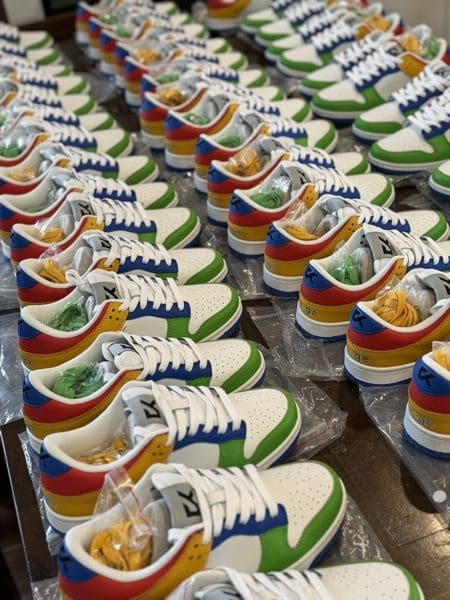
A staff polo gets worn when it has to. Bulk branded sneakers get worn because people actually want them. That difference matters when you are spending marketing, HR or operations budget on something meant to represent your business in the real world.
For companies that care about presentation, culture and visibility, sneakers sit in a sweet spot most promo products never reach. They are practical, high-wear and highly visible. They move through offices, event floors, warehouses, airports and client meetings without feeling like throwaway merchandise. When the branding is done well, they look considered, premium and on-brand rather than loud for the sake of it.
Why bulk branded sneakers work harder than standard merch
Most branded merchandise has a short life. A tote bag gets tucked away. A notebook is forgotten in a drawer. Even a decent hoodie can become just another item in rotation. Sneakers are different because they live at eye level, in motion, and out in public.
That creates a stronger return on visibility. A well-branded pair of sneakers can be worn weekly, sometimes daily, by staff, event crews or recipients who like the fit and the look. Every wear becomes a brand touchpoint. Not in a forced way, but in a way that feels natural and current.
There is also a perception shift that comes with footwear. Branded sneakers feel more valuable than generic promo items because they are. They signal investment in your team and attention to detail in your brand presentation. If you are trying to lift staff pride, sharpen event presence or create a reward that lands properly, footwear carries more weight than the usual swag bag filler.
Where bulk branded sneakers make the biggest impact
The strongest use case depends on who is wearing them and where. For customer-facing teams, branded sneakers create a cleaner, more unified look than a mix of personal footwear. In retail, hospitality-adjacent roles, activations and trade shows, that consistency matters. It helps staff look coordinated without making the uniform feel stiff.
For internal culture, the value is different. A team reward, milestone gift or onboarding kit that includes branded footwear feels premium and intentional. It tells people they are part of something well built. That matters for retention, morale and the way employees talk about your business.
Events are another obvious fit. Conference crews, roadshow teams and brand ambassadors spend long days on their feet. Giving them shoes that are actually wearable solves a practical problem while keeping the brand front and centre. That is a smarter outcome than handing out apparel that may not suit the conditions or the role.
There is also a place for ongoing workwear programs. Some businesses need repeat ordering, size flexibility and a reliable way to keep teams presented consistently across sites. In that setting, sneakers are not a one-off campaign item. They become part of a broader brand system.
What to look for when ordering bulk branded sneakers
The first decision is not the logo treatment. It is the purpose. Are these for a single event, a sales team, a warehouse crew, a national rollout or a client gift? That changes everything from brand placement to model selection to delivery timing.
Comfort and wearability should come first. If the shoe looks great in a mock-up but does not suit the workday, adoption drops fast. A marketing team at an expo may want something sleek and low-profile. A field team or operations crew may need a more durable style that can handle long hours. A startup may lean into fashion-forward silhouettes, while a national corporate may want something broadly wearable across departments.
Brand execution matters just as much. Premium branding is about restraint and placement. Too much decoration can make the product feel promotional in the worst way. The strongest results usually come from clean, confident branding that respects the original shoe design. Subtle heel marks, tongue logos, lace tags or custom packaging can often do more for perceived value than overloading the upper with graphics.
Lead time is another factor buyers often underestimate. Bulk orders sound straightforward until you are managing sizing, approvals, dispatch and internal stakeholders. If your launch date is fixed, the process needs to be clear from the start. That is especially true for multi-site teams or campaigns tied to a major event.
Branded sneakers in bulk: premium does not have to mean complicated
A lot of businesses assume branded footwear is too hard to manage at scale. That can be true if the process is loose, the artwork is not thought through, or the fulfilment side is patched together. It does not have to be that way.
The right supplier should make the path from idea to rollout feel commercially sensible. That means practical guidance on shoe selection, branding methods, quantity planning and approvals. It also means digital concepts early, so decision-makers can see what the final product is likely to look like before they commit budget.
For larger teams, ordering systems matter. Size collection can become the bottleneck if it is done manually through endless emails and spreadsheets. A cleaner ordering workflow saves time and reduces errors, which is particularly useful for HR teams, procurement managers and operations leaders trying to manage volume without creating admin pain.
There is also a quality question here. If you are putting your brand on recognisable footwear, the finish has to hold up. Crooked placement, poor adhesion or cheap-looking decoration can drag down the entire impression. Businesses investing in premium branded products are not just buying an item. They are protecting how the brand shows up.
The trade-offs buyers should think through
Not every bulk sneaker project needs the same approach. If budget is the main driver, you may choose a simpler branding treatment or a more accessible base model. If brand prestige is the priority, you might invest in a higher-profile shoe with more refined finishing. Neither choice is wrong. It depends on what success looks like.
There is also a balance between visibility and versatility. Bold branding can create more immediate recognition at an event. Subtle branding often leads to more repeat wear after the event is over. If your goal is long-term brand exposure, the quieter option often wins.
Minimum order expectations can vary too. Some companies only need a small team run, while others are planning for national distribution. Flexibility matters here. A supplier that can support both small launches and larger rollouts gives you more room to test, learn and scale without changing direction halfway through.
Why recognised footwear brands change the conversation
Putting your logo on a no-name product rarely creates excitement. Putting it on a respected sneaker brand changes how the item is received. People recognise the shape, trust the fit and understand the value straight away.
That matters in corporate settings because perception drives engagement. When staff receive branded footwear from names they already know, the product feels less like company merch and more like something worth keeping in rotation. That is where brand recall improves – not because the logo is bigger, but because the product itself has credibility.
It also lifts how your business is perceived externally. At activations, conferences and public-facing events, branded footwear from established labels gives your team a sharper, more considered look. It signals that your brand pays attention to quality, not just visibility.
Who should be considering bulk branded sneakers now
If you are responsible for events, staff uniforms, employee rewards, onboarding packs or campaign merchandise, this category deserves a closer look. Especially if you are tired of spending budget on products people accept politely and then forget.
Bulk branded sneakers make sense for businesses that want more from branded gear. More wear. More visibility. More team pride. More consistency across locations and roles. They are particularly strong for businesses with mobile teams, customer-facing staff, active event schedules or a brand image that needs to feel current rather than generic.
For many organisations, the smartest move is not replacing every merch item with footwear. It is using sneakers where they can do the most work – launches, premium gifting, team programs, field staff and high-visibility events. That is where the value becomes obvious.
At Corporate Kicks, that thinking sits at the centre of the offer. The goal is not to put a logo on a shoe for the sake of it. It is to create branded footwear people are proud to wear, backed by a process that works for real business timelines and real team rollouts.
If your next merch decision needs to lift brand presence as well as practical wearability, start with the item people will actually keep by the door and reach for on the way out.